
“Thank you for the food,” said the young boy with a smile, as he sat eating dinner with his family at the homeless shelter, enjoying the kalua pig and cabbage that had been prepared at the University of Hawai?i at 惭ā苍辞补 earlier that day.
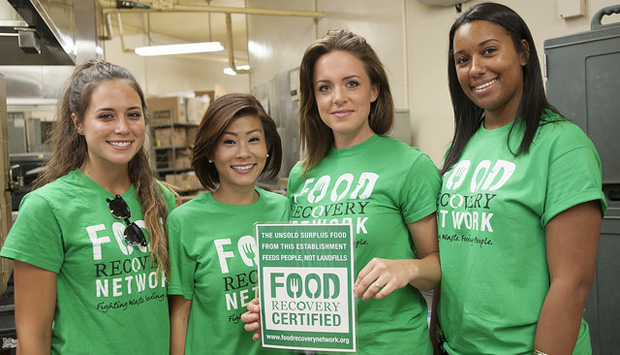
The recently became the first and only Food Recovery Certified chapter of the in the state. As the first organization in Hawai?i to earn this certification, the university is leading the way in efforts to end hunger and reduce the negative environmental effects of food waste. The certification was primarily the result of a group of students starting a UH 惭ā苍辞补 Food Recovery Network Chapter.
“I’m really excited about this program and it’s a great leadership opportunity as well,” said UH 惭ā苍辞补 Food Recovery Network President and student Heather Fucini. “I’m so excited that I can help the community while I’m going to school.”
1,000 pounds of food recovered
Chapter members work with the dining team to collect surplus food from the on-campus resident dining facility, Gateway Café. Since the Food Recovery Network chapter was established on campus in December 2015, the team has recovered more than 1,000 pounds of food and delivered it to the Institute for Human Services, which operates homeless shelters in Honolulu.
“We are very proud to become Food Recovery Certified at Gateway Café,” said Donna Ojiri, general manager of 惭ā苍辞补 Dining Services. “We are happy to be working with the Food Recovery Network Hawai?i chapter to do our part. We will continue to work with the Hawai?i chapter to increase our efforts throughout campus.”
The Food Recovery Network is a non-profit organization that works with college students to fight waste and feed people by donating surplus food from campus dining facilities to organizations that fight hunger. Since its founding in 2011, the Food Recovery Network has grown to include chapters at more than 180 colleges and universities. These chapters have recovered more than 1.2 million pounds of food, diverting it from landfills and providing meals to those in need.
Executive Director Connie Mitchell says she is very encouraged by community-inspired initiatives such as the UH 惭ā苍辞补 chapter of the Food Recovery Network and thrilled to be on the receiving end of the campus’ bounty. “It can’t get any better than this–recovering perfectly healthy food that would otherwise go to waste to feed hungry homeless families and individuals,” said Mitchell. “Savings to our food budget come at a great time with the expansion of our meal service to five shelter sites serving up to 900 meals a day.”
Program reduces waste
Nearly 40 percent of food produced in the U.S. is wasted and food accounts for more solid waste than paper, plastic or glass. Despite this, many Americans still go hungry, with an estimated 14 percent of U.S. households facing food insecurity. That means nearly 50 million Americans are at risk of hunger each day. Food waste in landfills also significantly contributes to greenhouse gas emissions as decaying food releases methane, a far more harmful substance than carbon dioxide.
The purpose of the Food Recovery Network certification program is to recognize and reward organizations for donating surplus food while also raising awareness about the benefits of food recovery. Earning certification through this unique program will help the University of Hawai?i offer safe, nutritious food to people in need.
Students want to expand program
Chapter members say they would like to expand UH 惭ā苍辞补’s program so other groups of students can help to recover food on other days of the week. Joy Nagahiro-Twu, UH 惭ā苍辞补 Food Recovery Network vice president said, “I hope that students actually get involved. This is a wonderful thing for the community. It’s very self gratifying and honestly is something where you can give back to your community in more ways than one.”
Fucini said, “I’m hoping that we are able to spread to all of the campuses here at UH and that we can make more of an imprint on the homeless crisis we are facing here in Hawai?i.”
Get involved
To get involved or for more information, email UH 惭ā苍辞补 Food Recovery Network’s Volunteer Coordinator Mariah Martino at uhmfrn@gmail.com.
惭ā苍辞补 Dining Services is managed by Sodexo, a leader in providing foodservice and quality of life solutions for colleges, schools, healthcare facilities and businesses around the world. Sodexo is deeply committed to improving the communities in which it operates through sustainable practices and community outreach initiatives. The company’s Sodexo Foundation, which is dedicated to ending childhood hunger, was an early supporter of the Food Recovery Network, awarding the organization its first large grant in 2013. Since then, Sodexo and the Food Recovery Network have developed a partnership to raise awareness about hunger and food waste and to encourage participation by as many colleges and universities as possible.

You can also view the photos on the .