Corals and humans share genes
Genes that can sense temperature and acidity are among those shared between humans and corals.


Genes that can sense temperature and acidity are among those shared between humans and corals.

Researchers find that large areas of intact coral reef, not disturbed by humans or climate change, harbor the greatest amount of genetic diversity

Researchers identified key and novel components of the molecular “toolkit” that allow corals to build their skeletons and described when these components are used.
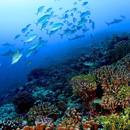
New study co-authored by UH Mānoa assistant professor Craig Nelson explores how microbialization destroys links in delicate marine food chain.

Using µCT (micro-computed tomography) scans, UH Mānoa’s Nyssa Silbiger and colleagues were able to calculate detailed bioerosion rates on coral reefs.

In the microscopic life that thrives around coral reefs researchers have discovered an interplay between viruses and microbes that defies conventional wisdom.
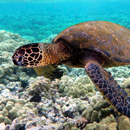
Three UH Hilo graduates and professor Misaki Takabayashi author a chapter in Ethnobiology of Corals and Coral Reefs

UH Mānoa professor Mark Hixon recognized as a first-cohort Fellow of the International Society for Reef Studies
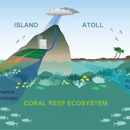
Scientists provide the first basin-scale investigation of the increase in productivity near coral reef islands and atolls referred to as the Island Mass Effect.
John Burns’ 3D Under the Sea has been selected as one of nine finalists in the Ocean 180 Video Challenge.