
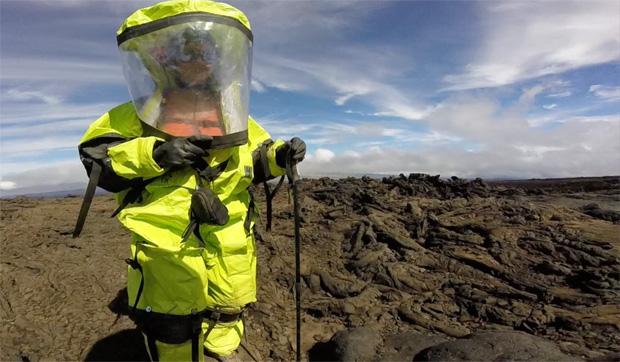
The six crew members of the fourth , have spent more than six months of their 12-month mission in a solar-powered dome on the slopes of Mauna Loa. The crew has been living in isolation as part of a research project simulating long-duration space travel.
“It’s fun to know you’ve made it halfway,” said crewmember Tristan Bassingthwaighte. The doctor of architecture candidate at UH Mānoa said, “Getting halfway is a great validation in the work you’re doing for yourself, academically or just personally. You also find you’re listening to Life on Mars by David Bowie a lot more often.”
This fourth mission is the longest in HI-SEAS history. As with the previous two missions in the NASA funded study, the current mission is focused on crewmember cohesion and performance.
Crew Commander Carmel Johnston, a soil scientist from Montana, said that she is looking forward to seeing her family. “It will be really fun to go swimming in the ocean, go for a run, feel the wind, smell the rain and other smells of nature, and be able to walk in a straight line that is longer than 20 feet,” she said. “Those things aside, life in the dome is pretty awesome.”
is scheduled to emerge from the habitat August 2016.
In May, NASA awarded HI-SEAS a third grant to keep the research project and its missions funded through 2019.
More HI-SEAS news
- VIDEO: – August 31, 2015
- – July 29, 2015
- VIDEO: – June 19, 2015
- – June 16, 2015
- VIDEO: – June 12, 2015
- – June 3, 2015
- VIDEO: – October 16, 2014
- – September 24, 2014
- VIDEO: – July 29, 2014
- VIDEO: – March 31, 2014
- – February 27, 2014
- – October 7, 2013
- VIDEO: – August 14, 2013
- – June 14, 2013
- – January 28, 2013
- – July 6, 2012
—By Kelli Trifonovitch